Transparency, Openness, and Our 2023-2024 Financials
Every year, as required by U.S. federal law for 501(c)(3) nonprofits, the Tor Project completes a Form 990, and as required by contractual obligations and state regulations, an independent audit of our financial statements. After completing standard audits for 2023-2024,* we added our federal tax filings (Form 990) and audited financial statements to our website. We upload all of our tax documents and publish a blog post about these documents in order to be transparent.
(These documents have been available on our website for a while, but we are just now able to publish this blog post because of limited capacity. We hope you understand!)
Transparency for a privacy project is not a contradiction: privacy is about choice, and we choose to be transparent in order to build trust and a stronger community. In this post, we aim to be very clear about where the Tor Project’s money comes from and what we do with it. This is how we operate in all aspects of our work: we show you all of our projects, in source code, and in periodic project and team reports, and in collaborations with researchers who help assess and improve Tor. Transparency also means being clear about our values, promises, and priorities as laid out in our social contract.
We hope that by expanding each subsection of this post and adding more detail, you will have an even better understanding of the Tor Project’s funding, and that you will be able to read the audited financial statements and Form 990 on your own should you have more questions.
*Our fiscal years run from July through June instead of following the calendar year.
Fiscal Year 2023-2024 Summary
The audit and tax filing forms we discuss in this post cover July 1, 2023 to June 30, 2024. During this fiscal period, the Tor Project realized some of the benefits of the organization’s investment in fundraising capacity with new staff, new policies and procedures, and a focus on diversifying the organization’s funding sources.
We’re happy to continue to see the results of this strategy pay off, and we could not have done this without your support and belief in the Tor Project’s vision.
Revenue & Support
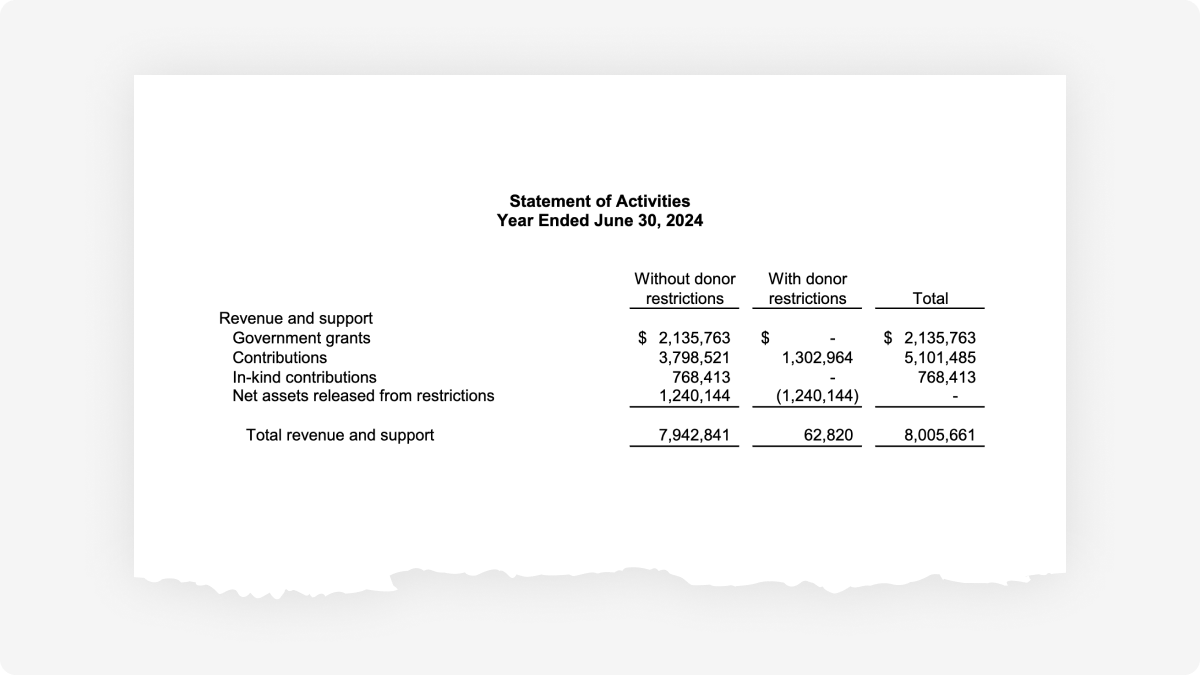
The Tor Project’s Revenue and Support in fiscal year 2023-2024, as listed in the audited financial statement, was $8,005,661.
In our Form 990, our Revenue is listed as $7,287,566.
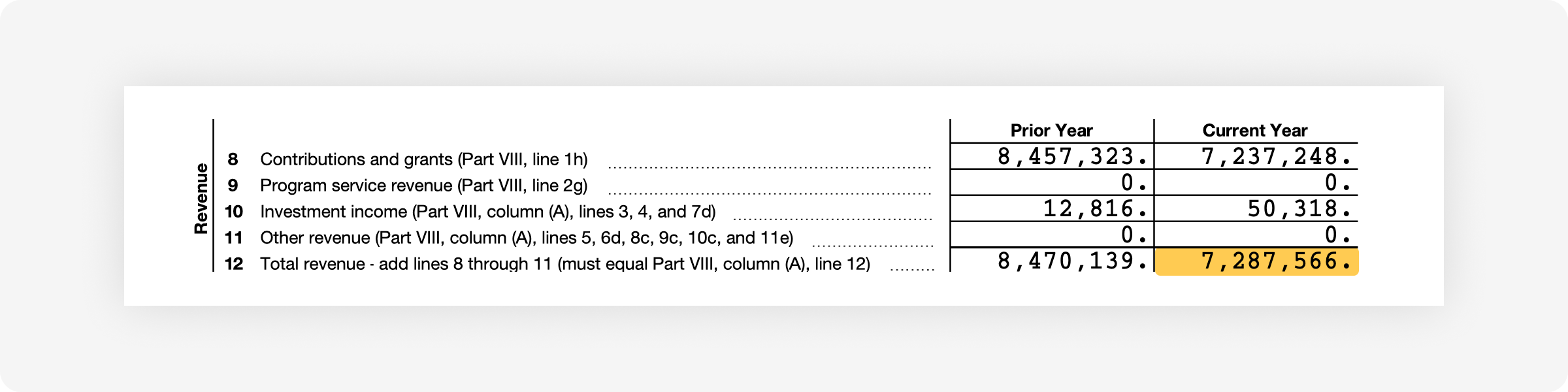
The difference between revenue on the Form 990 and the audited financials is not a mistake. The different revenue totals reflect differences in rules about how you must report tax revenue to the IRS and how you must report revenue in audited financial statements. The Tor Project’s audited financial statements include in-kind contributions ($768,413) as a form of revenue, while the Form 990 includes the in-kind contributions as an expense.
In-kind contributions is a term to describe non-monetary donations from the community. In 2023-2024, the Tor community contributed $768,413 in donated services or goods. That's an estimated 7,614 hours of software development, 1,894,720 words translated, cloud hosting services for 23 servers, and 26 certificates. Right now, this estimation does not include relay operator time and cost, but it should. We are working to better estimate both the hours of software development and how to represent the contributions made by relay operators. Stay tuned for the coming years! Clearly, Tor would not be possible without you. Thank you.
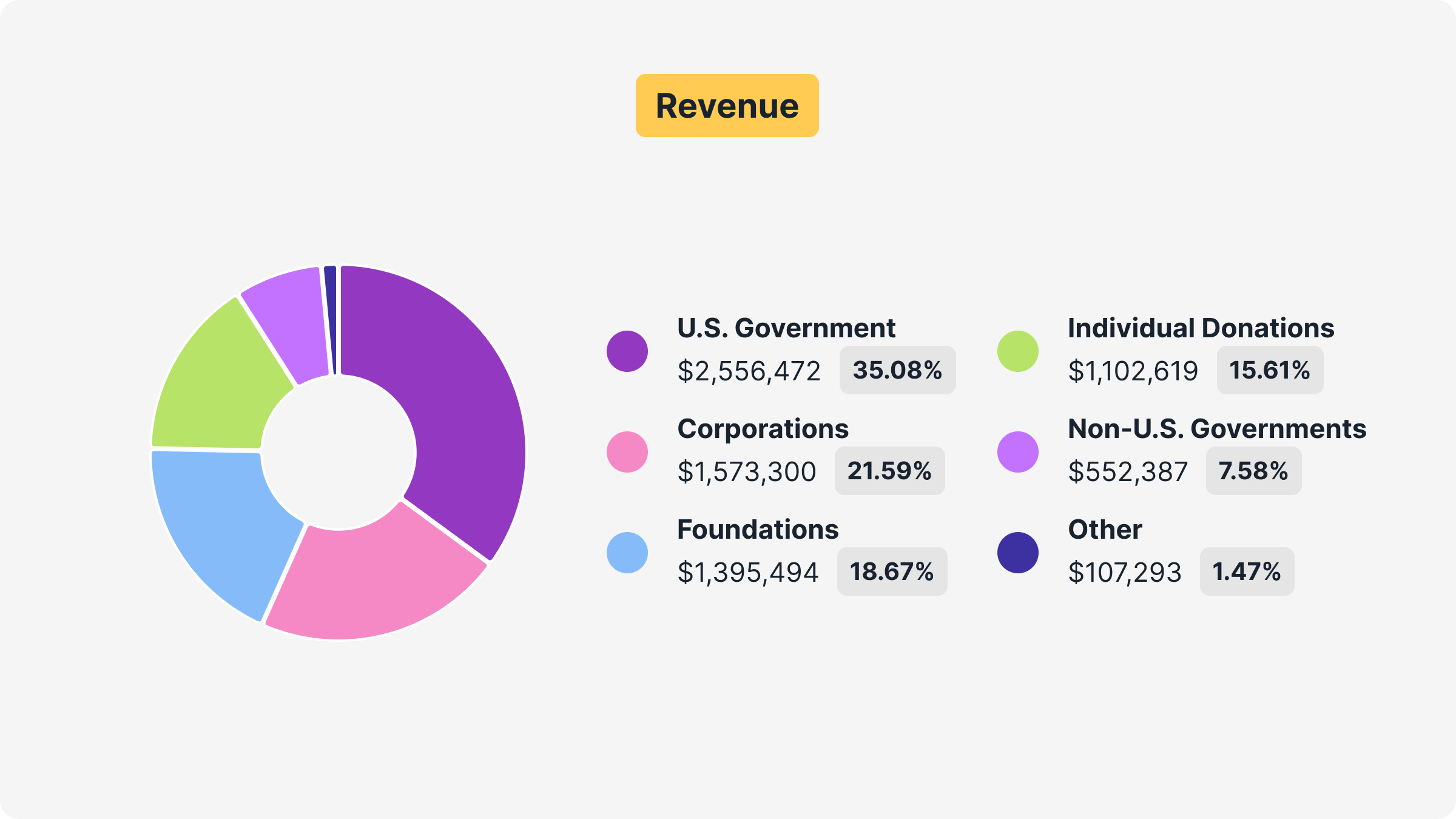
For the purposes of the following subsections of this blog post, we’ll be looking at the Revenue total following the 990, and breaking this total into the following categories:
- U.S. Government (35.08% of total revenue) $2,556,472
- Corporations (21.59% of total revenue) $1,573,300
- Foundations (18.67% of total revenue) $1,395,494
- Individual Donations (15.61% of total revenue) $1,102,619
- Non-U.S. Governments (7.58% of total revenue) $552,387
- Other (1.47% of total revenue) $107,293
U.S. Government
During this fiscal year, about 35.08% of our revenue came from U.S. government funds. For a comparison, in fiscal year 2021-2022, 53.5% of our revenue came from the U.S. government. You can see that our long-term mission to reduce our dependence on U.S. government funding has been coming to fruition. Of course there’s still more work to be done, and your support helps Tor realize this goal.
We get a lot of questions (and see a lot of FUD) about how the U.S. government funds the Tor Project, so we want to make this as clear as possible and show you where to find this information in the future in these publicly-available documents.
Let's talk specifically about which parts of the U.S. government have supported Tor, and what kind of projects they fund. Below, you can see a screenshot from the Tor Project's fiscal year 2023-2024 Form 990 on page 46 and 47, where we've listed all of our U.S. government funders. You will find text like this in all of our recent Form 990s:
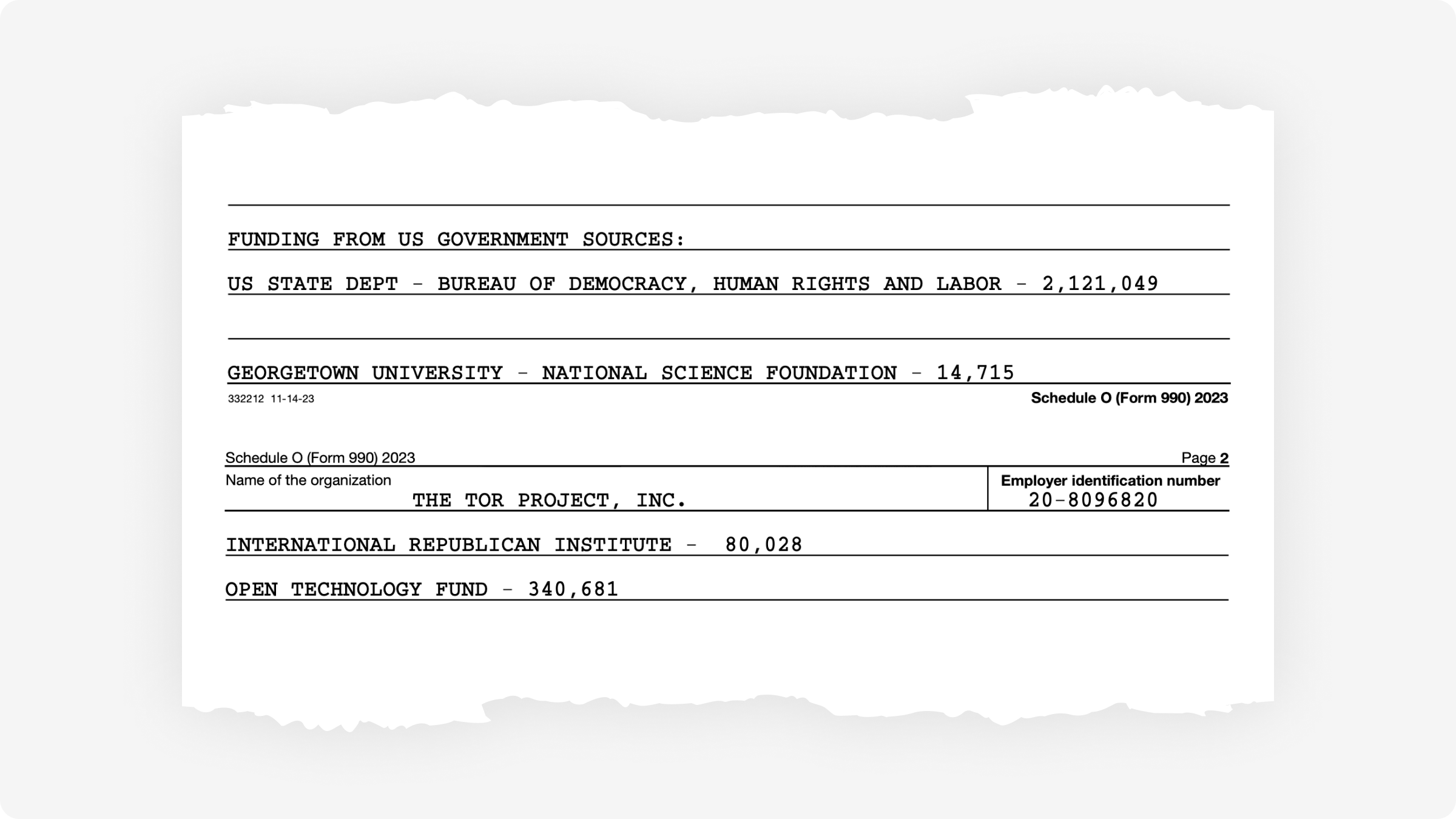
Now, we'll break down which projects are funded by each entity and link you to places in GitLab where we organize the work associated with this funding.
U.S. State Department Bureau of Democracy, Human Rights, and Labor ($2,121,049)
- Project: Rapid Expansion of Access to the Uncensored Internet through Tor in China, Hong Kong, & Tibet
- Description: The goal of this project was to improve circumvention technology in the Tor ecosystem, specifically in China. Guardian Project was a subgrantee on this project.
- Project: Tor VPN Client for Android
- Description: The goal of this ongoing project is to provide high-quality, device-wide privacy and censorship circumvention with a Tor VPN client on Android devices.
- Project: Combating Malicious Relays
- Description: The goal of this ongoing project is to reduce malicious relay activity and improve the health of the network.
- Project: Upgrading network relays to Rust
- Description: The goal of this ongoing project is to make users safer by ensuring the network is powered by a more secure implementation of Tor, called Arti.
- Some of this funding passed through the Tor Project to Open Observatory of Network Interference.
National Science Foundation + Georgetown University ($14,715)
- Project: Expanding Research Frontiers with a Next-Generation Anonymous Communication Experimentation (ACE) Framework
- Description: This project's goal was to develop a scalable and mature deterministic network simulator, capable of quickly and accurately simulating large networks such as Tor. This project utilized the Shadow Simulator.
International Republican Institute ($80,029)
- Project: Localizing Tor tools and documentation into Arabic, Chinese, and Swahili
- Description: The goal of this project was to localize Tor Browser, Tor circumvention tools, Tor documentation and training materials, and a Tor-based file sharing tool called OnionShare into Arabic, Chinese, and Swahili. The project also created localized demonstration videos on using Tor, circumventing censorship, and using OnionShare.
Open Technology Fund ($340,681)
Project: Support users to circumvent censorship against USAGM media sites
- Description: The goal for this ongoing project is to get more onion services set up in the world. To complete this goal, we will develop tools to help with setup and monitoring of onion services as well as help different USAGM media services to set up and monitor their onion services. You can read about some of the outcomes of the first year of this project, an effort to plant and grow more onions, on our blog.
Project: Rapid Response – Turkmenistan
- Description: The goal of this project was to ensure Tor tools and user support materials are available in Turkmen and that users in Turkmenistan have functional bridge options to connect to Tor.
Project: Tails Sustainability
- Description: The goal of this project is to support the sustainability of developing Tails.
Whether related to research in the field of privacy and anonymity online, innovation in censorship circumvention, or advancing human rights, government funding is always the result of an extremely competitive bidding process. From start to finish, these projects are designed and controlled by the Tor Project, its core contributors, and members of the community in response to specific contract or funding opportunities. The National Council of Nonprofits has published many excellent resources for learning about how this process works in the United States.
Corporations + Nonprofits
The next largest category of contributions at 21.59% of the total revenue was donations from corporations and nonprofits. In the 2023-2024 fiscal year, $1,573,300 was generated from this category. That’s an increase of 68% over the fiscal year prior, and a 154% increase from two fiscal years prior.
This is a result of our increased investment in a wider range of partnerships and support, including from organizations like OpenSats, Omidyar Network, and as part of our ongoing relationship with Mullvad VPN to develop Mullvad Browser and improve Tor Browser.
This category is also where we account for membership dues from our members like DuckDuckGo, Proton, and Word Unscrambler. We haven't listed every single entity you will see in our Form 990 in this blog post, but we hope you have a better understanding of what you might find in the Form 990.
Foundations
Of the revenue in fiscal year 2023-2024, about 18.67% came from foundations, at $1,395,494.
Some of these contributions are in the form of restricted grants, which means we pick a project that is on our roadmap, we propose it to a funder, they agree that this project is important, and we are funded to complete these projects. Examples in this category include Zcash Community Grants' support of Arti and Open Society Foundation’s support of the project to deploy a new bridge distribution system.
Also in this category are unrestricted funds, like support from #StartSmall, Craig Newmark Philanthropies, and Ford Foundation. These unrestricted funds are not tied to a specific project.
Individual Donations
The next category of contributions at 15.61% of the total revenue was individual donors. In the 2023-2024 fiscal year, supporters gave $1,102,619 to the Tor Project in the form of one-time gifts and monthly donations. These gifts came in all different forms (including ten different cryptocurrencies, which are then converted to USD).
Individual contributions come in many forms: some people donate $5 to the Tor Project one time, some donate $100 every month, and some make large gifts annually. The common thread is that individual donations are unrestricted funds, and a very important kind of support. Unrestricted funds allow us to respond to censorship events, develop our tools in a more agile way, and ensure we have reserves to keep Tor strong in case of emergencies.
Non-U.S. Governments
This line item represents funding that comes from Sida, a government agency working on behalf of the Swedish parliament and government, with the mission to reduce poverty in the world. Sida supports the Tor Project so that we can carry out user research, localization, user support, usability improvements, training for communities, and training for trainers. This support is how we are able to meet our users and to carry out the user experience research we do to improve all Tor tools.
Other
$107,293 of our revenue is from and for the Privacy Enhancing Technologies Symposium. Tor supports the yearly PETS conference by providing structure and financial continuity.
Expenses
OK, we've told you how we get funding (and which documents to look at to learn more). Now what do we do with that money? Based on the Form 990, our expenses were $7,343,602 in fiscal year 2023-2024.

Like I discussed in the Revenue section above, the expenses listed in our Form 990 and audited financial statements are different. Based on the audited financial statements, our expenses (page 7) were $8,112,015.
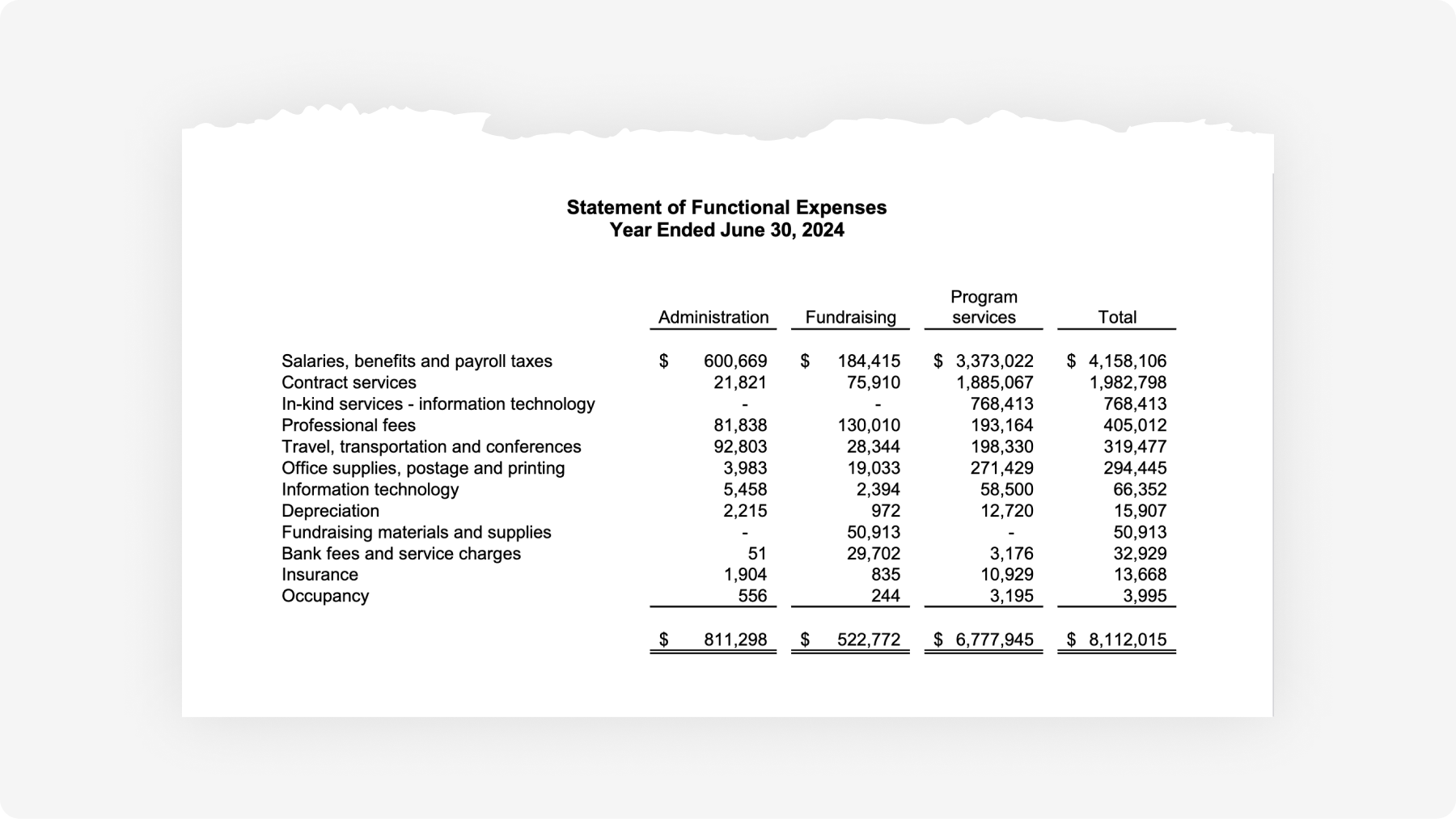
Why the difference? The Form 990 does not include in-kind contributions--the audited financial statement does. For the rest of this blog post, as above, we'll be looking at the Expenses total following the Form 990.
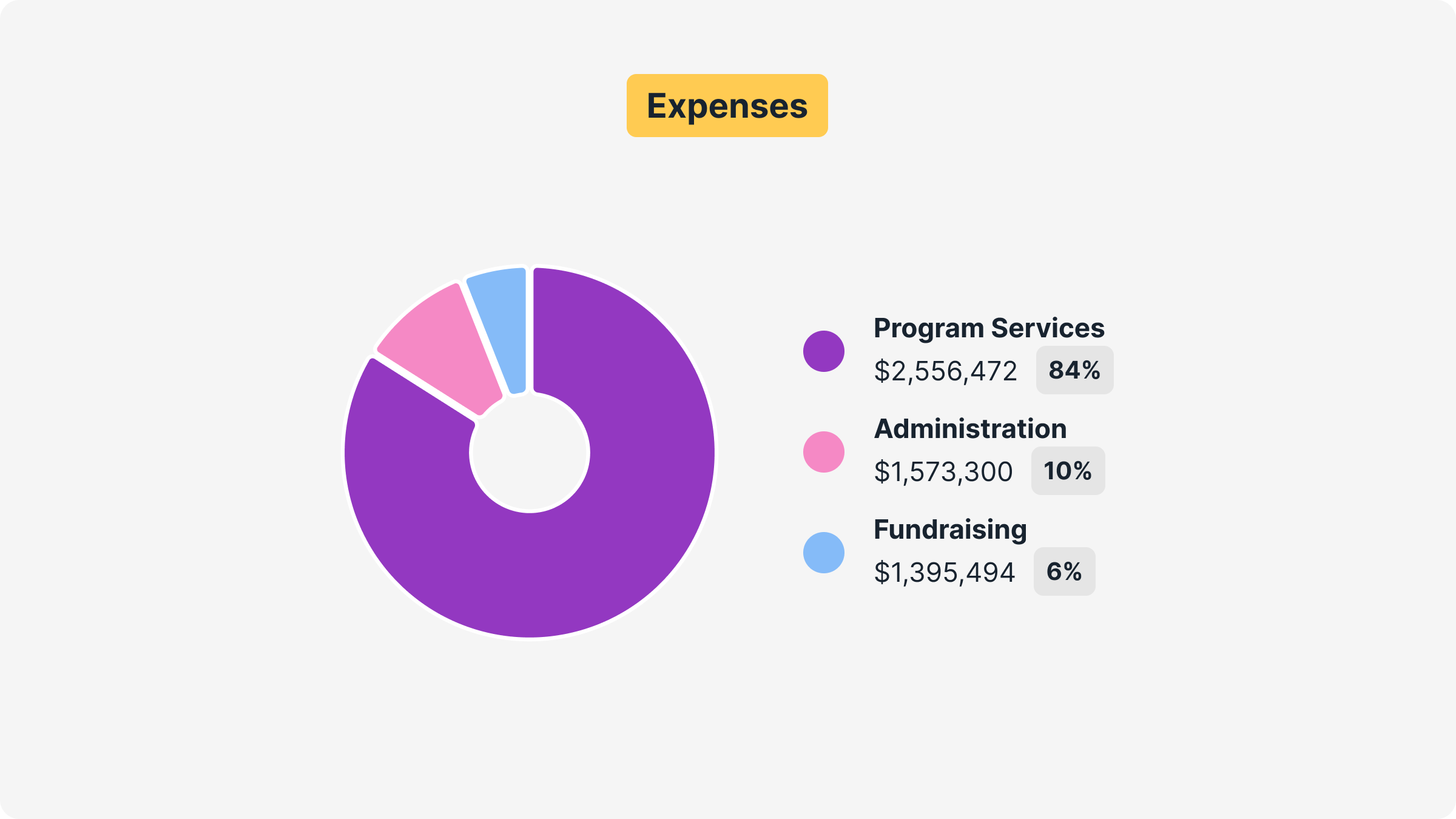
We break our expenses into three main categories:
Administration: costs associated with organizational administration, like salary for our Executive Director, office supplies, business insurance costs;
Fundraising: costs associated with the fundraising program, like salary for fundraising staff, tools we use for fundraising, bank fees, postal mail supplies, swag; and
Program services: costs associated with making and maintaining Tor and supporting the people who use it, including application, network, UX, metrics, and community staff salaries; contractor salaries; and IT costs. If you want to learn more about the work considered "program services," you should read our list of sponsored projects on our wiki.
In the 2023-2024 fiscal year, 84% of our expenses were associated with program services. That means that a very significant portion of our budget goes directly into building Tor and making it better. Next comes administration at 10% and fundraising at 6%.
Ultimately, like Roger (the Tor Project's Co-Founder) has written in many past versions of this blog post, it's very important to remember the big picture: Tor's budget is modest considering our global impact. Compared to the cost of operating a VPN, Tor’s cost per user is much smaller, because of our distributed design and the contributions of thousands of relay operators. And it's also critical to remember that our annual revenue is utterly dwarfed by what our adversaries spend to suppress people's human right to privacy and anonymity, making the world a more dangerous and less free place.
In closing, we are extremely grateful for all of our donors and supporters. You make this work possible, and we hope this expanded version of our financial transparency post sheds more light on how the Tor Project raises money and how we spend it. Remember, that beyond making a donation, there are other ways to get involved, including volunteering and running a Tor relay!
Comments
We encourage respectful, on-topic comments. Comments that violate our Code of Conduct will be deleted. Off-topic comments may be deleted at the discretion of the moderators. Please do not comment as a way to receive support or to report bugs on a post unrelated to a release. If you are looking for support, please see our FAQ, user support forum or ways to get in touch with us.